Can You Rent a Granny Flat to Anyone in Queensland 2026
You can rent a lawful Queensland granny flat to someone outside the main household, subject to the applicable approval conditions and rental requirements. Check older consents for occupancy restrictions and ask a certifier whether the proposed arrangement requires additional fire or sound separation work.
Last updated June 2026. Queensland uses state planning codes plus local council assessment. Treat this as a starting point, not a substitute for a town planner or certifier on your lot. See the Queensland Government granny flat hub and QBCC for current requirements. Rental rules relaxed. The certifier did not. If overlays apply, you’re still in a code or impact assessment.
What the 2022 Queensland reform changed
Before the reform, many councils treated secondary dwellings as dependent on the main house, which limited who can live there. The updated state planning framework aligns Queensland with NSW and Victoria on rental flexibility. You still confirm the lot against the current planning scheme, because accepted development on one street can be code assessable on the next if character or flood mapping applies. Don’t assume the 2022 press release is your approval.
The Queensland Government guidance explains that existing occupancy conditions may require a change application. The rental reform does not remove building or fire-safety requirements, and tax treatment depends on the actual arrangement.
For Brisbane-specific numbers, see our granny flats Brisbane guide.
Rules you still must meet
Queensland rental freedom does not waive building approval. Check the current secondary-dwelling rules with your council and the Queensland Government planning pages before you advertise the flat on a rental platform.
Rental freedom doesn’t remove construction or siting rules. A lawful Queensland secondary dwelling commonly needs:
- Approval under the relevant code (commonly accepted development or code assessable development)
- A building permit from a private certifier
- Compliance with the floor-area rules applying in the local scheme
- Siting and relationship to the main dwelling under applicable local provisions
- Adequate parking, setbacks and utility connections
| Topic | Typical Queensland expectation |
|---|---|
| Who can live there | Any tenant, family or not |
| Floor-area control | Check the applicable council planning scheme |
| Separate title sale | Not permitted without subdivision |
| Short-term letting | Check local council STRA rules |
Official material is on the Queensland Department of State Development, Infrastructure and Planning website.
Council approval: what it looks like in practice
Queensland councils apply the Queensland Development Code and local planning schemes. Many straightforward granny flats on standard residential lots qualify for code assessment rather than impact assessable development.
Accepted development pathway
When your design meets every code provision, council can classify the work as accepted development. You still lodge documentation and obtain a building permit, but you skip a full development application in many cases.
Code assessable pathway
If one element needs discretion (setback variation, character area, flood overlay), council assesses against the code without the long impact-assessment process unless triggers escalate.
Impact assessable pathway
Complex sites, non-compliant sizes or sensitive zones can require impact assessment, public notification and longer timeframes. Budget accordingly if your block has overlays.
Building permit and final certificates
Before occupation, obtain the completion documentation required for the building and approval pathway. Ask the certifier which inspections and records are outstanding, then confirm the intended rental use with the insurer and relevant tenancy guidance. Don’t promise a tenant a move-in date based only on the builder’s expected finish.
Landlord obligations once rented
Queensland rental law applies to granny flat tenancies the same as any house. That includes entry rules, maintenance, smoke alarms, minimum housing standards and bond handling through the Residential Tenancies Authority. Update your home and landlord insurance before signing a lease. Our granny flat insurance Australia overview covers common gaps. You don’t get a family-only exemption from the RTA just because mum helped pay for the slab. If you’re charging market rent, you’re a landlord under Queensland law.
Costs and returns
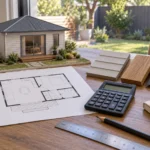
Price the lawful dwelling and its site work before modelling rental income. Obtain local appraisals and allow for vacancy, management and maintenance. Use the budget calculator as an assumption worksheet, then replace its figures with written quotes.
How Queensland compares to other states
Queensland does not have one statewide granny-flat floor-area allowance. Council schemes and the property assessment determine the relevant controls. Compare the state frameworks without treating a size mentioned for one council as a national or state rule.
Frequently Asked Questions
Can I rent my Queensland granny flat on the open market?
Yes. State reforms removed family-only occupancy restrictions for compliant secondary dwellings.
Do I still need council approval in Queensland?
Yes. Planning assessment and a building permit are still required even when rental occupancy rules relaxed.
Can I use the granny flat for Airbnb?
Maybe. Short-term rental is regulated at local council level. Check your LGA’s short-term accommodation policy before listing.
Can I sell the granny flat separately?
Not without a formal subdivision, which is a different and commonly difficult process from building a secondary dwelling.
What happens if I rent before final certification?
You risk fines, insurance denial and orders to vacate. Wait for the certifier’s final approval.
By The Granny Flat Guide Team. Verify your lot on the Queensland planning portal and with your local council.
Primary sources
These cards are an editorial summary of official pages. The Granny Flat Guide is not a certifier, council or licensed builder. Check the live official URL before you lodge or sign.
- Your Home (Australian Government)Your Home: Australia's guide to environmentally sustainable homes
- Australian Building Codes BoardNational Construction Code
- Queensland PlanningPlanning Act 2016
- QBCC (Queensland)Queensland Building and Construction Commission licensing
See our editorial standards for how we research and update guides.
Related guides