Colorbond vs Tile Roof for a Granny Flat: What to Compare
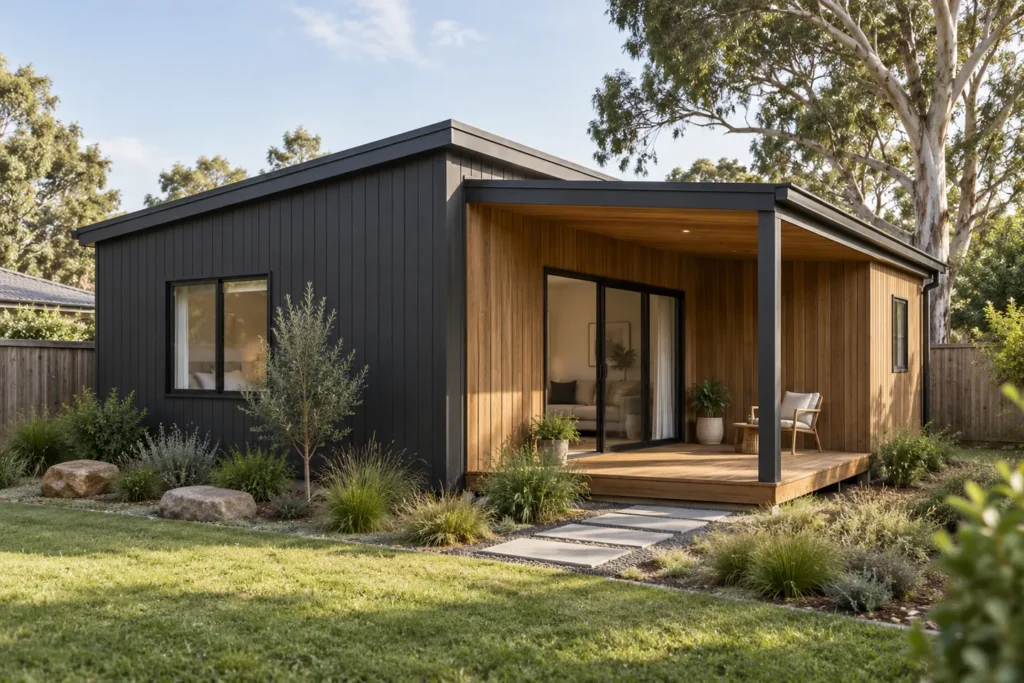
A Colorbond vs tile roof comparison for a granny flat should cover the complete roof system, its suitability for the design and the installed price. Neither material is automatically the better choice for every small dwelling. Check the structural design, roof pitch, site exposure and energy specification before choosing by appearance.
Our earlier comparison overstated universal savings and service lives. We have removed those unsupported price bands and lifespan promises. Obtain a quote and the product-specific installation and warranty conditions for the proposed roof.
Compare products rather than broad labels
COLORBOND steel is a branded coated-steel product used in roofing systems. Tiles also vary: Monier’s current range, for example, separates concrete and terracotta products and offers different profiles. A comparison needs the actual profile, finish and system details.
Ask the designer to nominate the roof specification and the installer to price it. Check minimum pitch, support and fixing requirements, penetrations, flashings, drainage and any restrictions relevant to the location. Don’t assume every sheet profile or tile can be used on the same low-pitch design.
Already chosen a kit? Start with its specified roof. If you want to substitute tiles for steel, send the actual product details to the supplier and responsible designer before purchasing anything: the proposed change may affect pitch, framing, fixings and the supporting documentation.
Have structural changes priced with the covering
Check the structural design. You’re comparing more than the covering when a different roof load requires changes elsewhere in the building, so ask the designer to identify those changes and have them priced in the same quote. Don’t assume a heavier covering always requires a different slab.
Compare the roof as installed, including supporting work, insulation, flashings, gutters and labour. Delivery and access can matter on a backyard site, so give both installers the same site information. Identify whether lifting, scaffolding, disposal and temporary weather protection are included.
Our quote comparison guide helps align those scopes. Comparing only a supply price per square metre leaves too much of the project outside the decision.
Coordinate heat, sound and moisture performance
The roof covering works with the rest of the construction. Colour, insulation, ventilation, ceiling details and the building’s climate location all need consideration. Don’t infer the finished room’s comfort from material mass or a reflective-colour claim alone.
Ask the energy assessor which roof assumptions appear in the assessment and whether a proposed change needs review. The Your Home insulation guidance is useful background for discussing the complete assembly. It is not a substitute for the specified construction details.
If rain noise matters, ask about the proposed roof-and-ceiling assembly and any relevant performance evidence. If moisture risk is a concern, have the practitioner explain the membrane and ventilation details. These are design questions for the system, not reasons to declare one covering universally quiet or condensation-free.
Check maintenance and warranty conditions
| Question | Why it belongs in the comparison |
|---|---|
| Which product and finish are quoted? | Warranty and maintenance information should match the actual specification. |
| Does the site exposure affect suitability? | Ask about coastal, industrial, bushfire or other relevant conditions. |
| What maintenance is required? | Plan access for inspection, cleaning and repairs without assuming the roof is maintenance-free. |
| Who handles installation defects? | A material warranty and an installer’s responsibility cover different questions. |
| Are later additions anticipated? | Solar, exhausts or other penetrations need coordinated installation details. |
Before comparing warranty years, read the exclusions. A long material warranty won’t answer who fixes a flashing installed incorrectly, and a stated warranty period isn’t a prediction of service life. Keep the product specification and installer records together so you can identify the right party if a problem appears.
Choose the roof that fits the whole brief
Review appearance beside the main house, planning or heritage controls, structural compatibility, performance and installed price together. A tile that suits the street may be worth pricing; a specified steel roof may fit the kit and programme well. Neither conclusion requires declaring the alternative unsuitable for granny flats as a category.
Compare modern concepts and traditional designs with the designer, then keep the selected roof in the documented scope.
Frequently Asked Questions
Can I replace a kit’s specified steel roof with tiles?
Ask the supplier and structural designer to assess the change. Do not substitute the covering without checking the supporting design and approvals.
Is one option always cheaper?
No. Compare complete installed quotes, including any structural or design changes, rather than supply prices alone.
Which lasts longer?
That depends on the product, installation, exposure and maintenance. We do not have evidence for a universal lifespan comparison across every system.
By The Granny Flat Guide Team. Last updated October 2026. About our research · Project budget calculator
Primary sources
These cards are an editorial summary of official pages. The Granny Flat Guide is not a certifier, council or licensed builder. Check the live official URL before you lodge or sign.
- Your Home (Australian Government)Your Home: Australia's guide to environmentally sustainable homes
- Australian Building Codes BoardNational Construction Code
- NSW Planning PortalState Environmental Planning Policy (Housing) 2021
- Victorian Building AuthorityBuilding Act 1993 / small second dwelling settings
- Queensland PlanningPlanning Act 2016
- WA Planning (DPLH)Planning and Development Act 2005
- PlanSA (South Australia)Planning, Development and Infrastructure Act 2016
- QBCC (Queensland)Queensland Building and Construction Commission licensing
See our editorial standards for how we research and update guides.