Granny Flat Depreciation Schedule Australia: What to Check
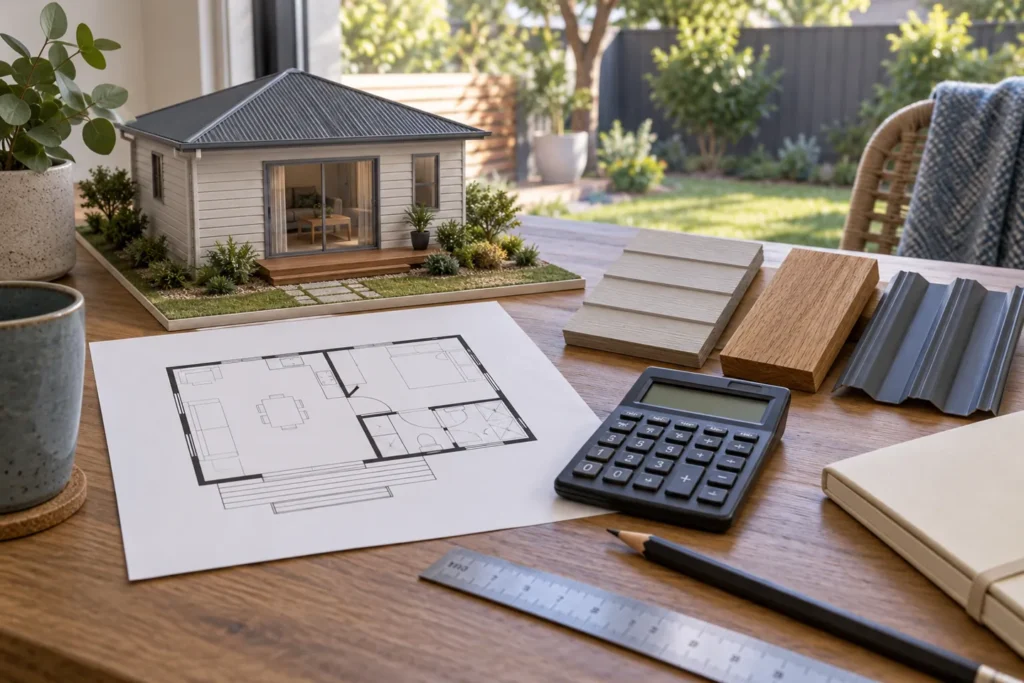
A granny flat depreciation schedule in Australia records potential deductions for eligible capital works and depreciating assets. It does not guarantee a refund or a fixed annual deduction. The claim depends on the costs, assets, dates, ownership and income-producing use of the property.
By The Granny Flat Guide Team. Updated 2 October 2026. About our research.
Correction: earlier wording promised deduction ranges and refunds, restricted cost estimates to quantity surveyors alone, and overstated CGT outcomes. Those claims have been removed.
| Record | What to keep visible |
|---|---|
| Building invoices | Work description, amount, date and any cost split |
| Asset purchases | The item, purchase date, installation cost and private use |
| Rental history | When the dwelling was available for rent and periods of private use |
| Previous claims | Schedules and tax records needed to avoid claiming the same cost twice |
What information belongs in a depreciation schedule?
Start with the construction contract, variations, final invoices and the completion date. Keep separate records for appliances and other assets, including purchase and installation dates. Give the preparer the actual figures you have instead of assuming that a building’s current value is its construction cost.
The ATO’s guidance on rental expenses claimed over time addresses capital works and depreciating assets. If construction costs are unavailable, it describes obtaining an estimate from an appropriately qualified person. A quantity surveyor is one possible source; it is incorrect to say only a quantity surveyor can ever estimate the costs.
Ask your tax agent which records are sufficient and where an estimate is needed before commissioning a report. If the granny flat shares services or expenses with the main house, flag that arrangement rather than letting the preparer assume a wholly separate rental property.
Keep capital works and individual assets separate
Building work and removable assets do not necessarily receive the same tax treatment. A schedule should explain the categories and the basis used for each amount. Don’t apply one advertised percentage to the entire project invoice, which may also include land-related spending, services or other costs requiring separate treatment.
Ask the preparer to identify any estimates, the documents relied on and how items supplied within a combined building contract were allocated. Check that appliances or fit-out items have not been counted twice, once in the building total and again as separately purchased assets.
Keep replacement records after handover. If you replace an appliance, pass the invoice and dates to your tax agent rather than continuing to use the original schedule without review. A report is a record to maintain, not a substitute for checking what actually happened during the year.
A deduction is not a dollar-for-dollar refund
Do not put the face value of a deduction into your cash-flow spreadsheet as cash received. Your tax agent needs to work out the effect on your return. The result depends on your wider tax position, and a schedule on its own cannot promise money back into your bank account.
Keep the construction decision separate from the tax calculation. A deduction does not remove the need to fund loan repayments, repairs, insurance or periods without rent. Use the cost breakdown guide to establish actual spending and discuss the tax treatment of those records afterwards.
Be cautious with marketing examples that describe a “typical” refund without listing the assumptions. Ask which costs, use dates and taxpayer circumstances produced the example, and whether any of them match your proposed project. If they don’t, leave that figure out of your budget.
Tell your adviser how the dwelling is used
Document commercial rent, family occupation, private use and any changes between them. Give your tax agent the lease dates and details of shared costs. A granny flat occupied by a relative under an informal arrangement should not automatically be treated like a property rented at market rates.
The ATO’s rental property guide explains that expenses differ in deductibility and timing, and that apportionment can be needed. Ask your adviser how to record mixed use before lodging a return.
For lifetime family accommodation, also read our granny flat agreement explainer. The legal arrangement and the tax treatment need to be considered together. Don’t describe a contribution to household costs as commercial rent simply to match a depreciation calculator.
Discuss CGT and the report fee before ordering
Request a written fee and scope for any report. Ask whether the price includes an inspection, asset information, later revisions and responses to your tax agent’s questions. We have not established a current nationwide fee range or a standard savings guarantee, so compare actual offers.
Then ask your tax agent about the sale position. The ATO’s rental property guidance notes that capital works deductions claimed or claimable can affect the CGT cost base. A future CGT result cannot be reduced to an assumed percentage of the yard.
Keep the report, supporting invoices and written tax advice with the property records. Our property-value guide helps separate resale assumptions from rental cash flow when you decide whether the overall project is worthwhile.
Frequently Asked Questions
Must every cost estimate come from a quantity surveyor?
No. The ATO refers to an appropriately qualified person when an estimate of unavailable construction costs is needed. Ask your tax agent what evidence and qualifications suit the particular claim.
Will a schedule guarantee a tax refund?
No. It supplies information for assessing deductions. Your entitlement and the effect on your tax return depend on your circumstances.
Can I claim the same amount after the use changes?
Don’t assume so. Tell your tax agent about private use, family occupation, rental dates and asset replacements so the claim can be reviewed.
How much does council approval add to your build budget?
Council and certifier fees sit outside the builder quote. In NSW, a CDC pathway through a private certifier often lands between roughly $3,000 and $8,000 once survey, BASIX and Sydney Water checks are included, while a full DA can cost more because of longer consultant time and holding costs. Victoria and Queensland use different fee schedules, so treat any single number as a starting point. Model your own project in our cost calculator, then browse the supplier hub or send us an enquiry when your footprint is settled.
What design choices affect approval speed?
Setbacks, height, floor area and tree protection overlays decide whether you stay on a fast CDC track or drop to a slower DA. Staying under common 60 sqm internal caps, keeping adequate side and rear setbacks and connecting services without major easement conflicts usually keeps the pathway simpler. If your block is sloped, flood-affected or heritage-listed, expect extra reports before council or your certifier can sign off. Use the setback checker and approval wizard against your address before you pay for custom drawings.
Primary sources
These cards are an editorial summary of official pages. The Granny Flat Guide is not a certifier, council or licensed builder. Check the live official URL before you lodge or sign.
- Your Home (Australian Government)Your Home: Australia's guide to environmentally sustainable homes
- Australian Building Codes BoardNational Construction Code
- NSW Planning PortalState Environmental Planning Policy (Housing) 2021
- Victorian Building AuthorityBuilding Act 1993 / small second dwelling settings
- Queensland PlanningPlanning Act 2016
- WA Planning (DPLH)Planning and Development Act 2005
- PlanSA (South Australia)Planning, Development and Infrastructure Act 2016
- QBCC (Queensland)Queensland Building and Construction Commission licensing
See our editorial standards for how we research and update guides.
Related guides