Dual Occupancy vs Granny Flat: Planning Differences Explained
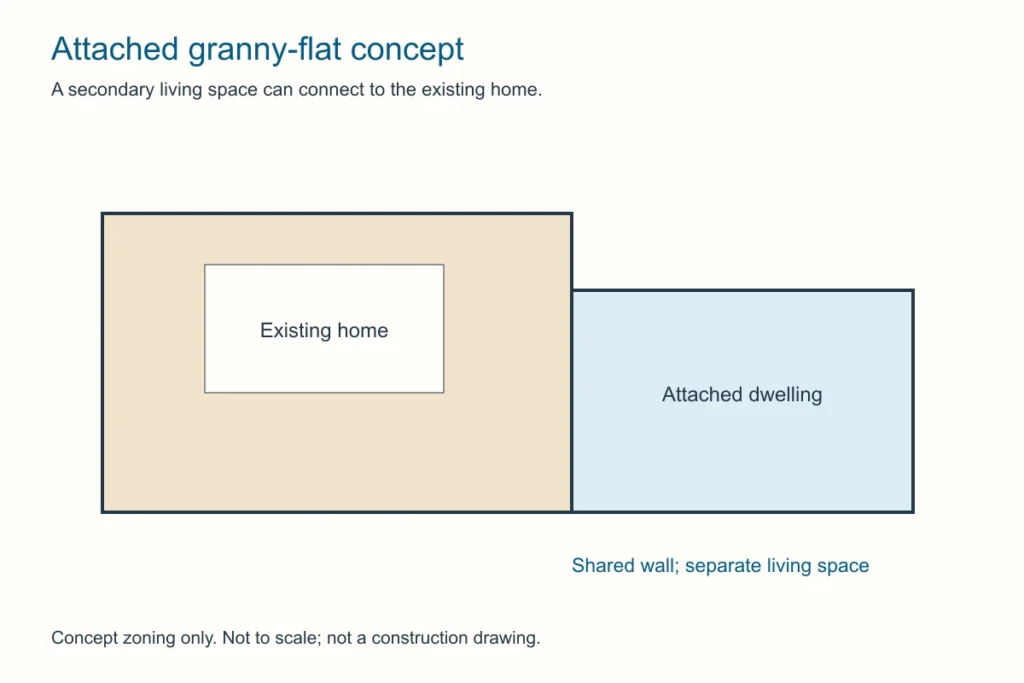
A dual occupancy vs granny flat decision starts with the planning category and your intended use. Two households on one property do not automatically create the same type of development. Tell the planner whether you want family accommodation, rental use, separate titles or a combination before commissioning plans.
The applicable definitions and approval routes depend on the jurisdiction and property. Neither a second kitchen nor a separate entrance settles the category on its own.
Establish the proposal before comparing designs
Dual occupancy generally describes two dwellings on one lot, while a granny flat is a common name for accommodation associated with a main dwelling. The precise legal definitions matter more than those broad descriptions. Don’t assume that two dwellings must be equal in size to be a dual occupancy, or that a secondary dwelling is restricted to relatives.
Ask the planner to identify the relevant definition and operative controls for the address. Include the existing dwelling, proposed arrangement, intended occupants and any future subdivision goal in the brief. A builder’s product label is not a planning assessment.
Our granny flat definition guide explains the terminology. The state overview points to the separate frameworks.
Separate dwelling approval from subdivision
A dual occupancy does not guarantee that the land can be subdivided. Separate-title feasibility needs its own assessment of zoning, applicable standards, services, access and the proposed title arrangement. Get that advice before a financial plan assumes two independent sales.
For NSW secondary dwellings under the Housing SEPP, the official guidance states that subdivision is not permitted. Victoria’s small second dwelling guidance also distinguishes the dwelling category from separate subdivision.
Those examples should not be turned into an unsupported rule for every development across Australia. Read our subdivision guide and ask for advice on the category actually proposed.
Compare the property constraints for each option
| Question | What to assess |
|---|---|
| Is the use permitted? | Current zoning, definitions and any relevant site-specific provisions |
| Can the design fit? | Floor-area measurement, setbacks, height, open space, access and other applicable standards |
| What constraints apply? | Title restrictions, easements, heritage, hazards and servicing requirements |
| Which approvals are needed? | Planning, building and any separate subdivision or utility processes |
| What can be occupied or rented? | Approval conditions, completion documents and rental requirements |
Have both concepts assessed against the same site information. A lot-size figure on its own cannot establish feasibility. If one option needs a substantially different design or services arrangement, put that difference into the scope comparison.
Build two complete budgets
Ask suppliers to price the same level of finish and to identify work outside their contracts. Include professional fees, reports, approvals, connections and external work. Where subdivision is a goal, obtain separate advice and quotes for that process rather than treating it as a paperwork add-on.
Don’t assume that one category adds more value or produces a higher return. Obtain local valuation and rental evidence for the actual proposals. A larger construction budget can buy a different asset without guaranteeing a better financial outcome.
Use the quote comparison guide to reconcile scopes and the property-value guide to separate cost from value.
Keep future intentions in the brief
Explain any likely change of use early. A dwelling intended for a parent today may later be considered for rental, while a proposal intended for separate sale may depend on approvals that a family accommodation project does not need.
Ask which future options the proposed approvals actually preserve. Record those limits with your legal and planning advice, then choose the design and contract accordingly. Don’t pay for two dwellings on the assumption that every later ownership arrangement will be available.
Frequently Asked Questions
Does dual occupancy mean I can sell each dwelling?
No. Separate sale generally requires an appropriate title arrangement, which needs its own feasibility and approval checks.
Are granny flats only for family?
Occupancy rules depend on the jurisdiction and approval conditions. The informal name does not establish a family-only restriction.
Is one approval route always faster?
No. Ask about the route and expected programme for each actual proposal. A generic category cannot establish a turnaround time.
By The Granny Flat Guide Team. Last updated October 2026. About our research · Project budget calculator
Primary sources
These cards are an editorial summary of official pages. The Granny Flat Guide is not a certifier, council or licensed builder. Check the live official URL before you lodge or sign.
- Your Home (Australian Government)Your Home: Australia's guide to environmentally sustainable homes
- Australian Building Codes BoardNational Construction Code
- Victorian Building AuthorityBuilding Act 1993 / small second dwelling settings
- QBCC (Queensland)Queensland Building and Construction Commission licensing
See our editorial standards for how we research and update guides.