Granny Flat Parking Requirements: Australian State Guide
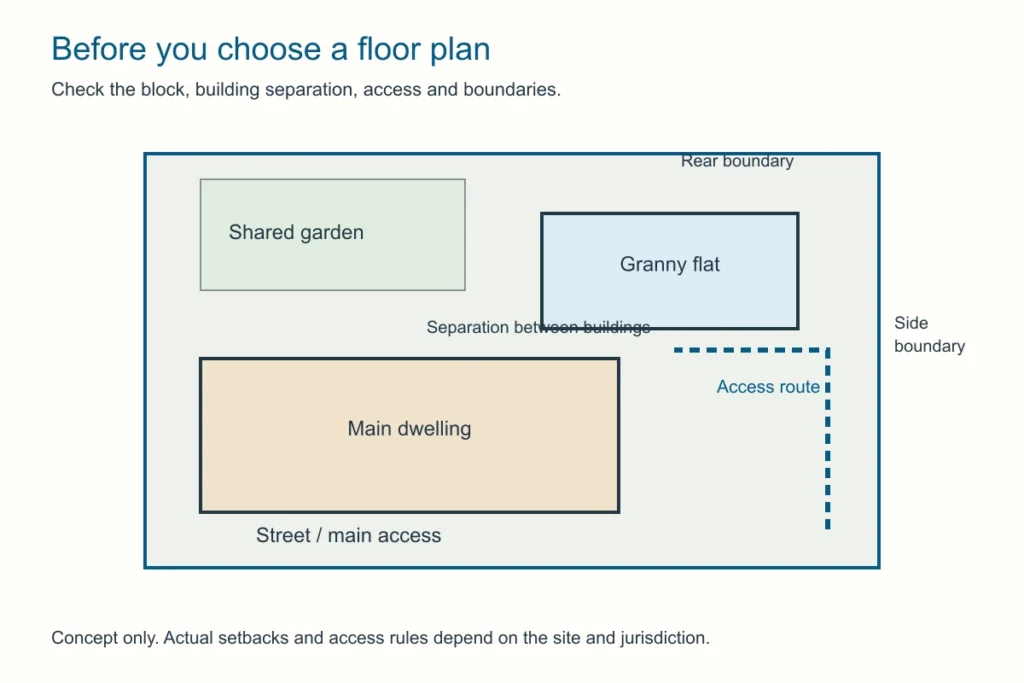
NSW complying development for secondary dwellings up to 60 m² usually needs no extra parking space. Victoria depends on zone and overlays: many GRZ sites waive an extra bay, while NRZ or heritage overlays often do not. Extra paving can eat garden area and delay approval, so confirm the rule before you lock the floor plan.
Why Parking Rules Matter
Adding a second dwelling to a residential block can trigger parking requirements under state planning schemes. Councils worry about on-street congestion, especially in areas where driveways and garages are already limited.
- Driveway extensions: Building extra parking space may require paving garden areas or widening driveways.
- Reduced garden space: Parking takes up outdoor areas that could be used for the granny flat itself.
- Approval delays: Councils may refuse or defer applications if parking compliance is unclear.
Fast-track pathways like NSW’s Complying Development Certificate (CDC) and Victoria’s planning exemptions often waive parking requirements, making them attractive options for families on standard suburban blocks.
New South Wales: No Extra Parking Under CDC
NSW’s Complying Development Certificate (CDC) pathway under SEPP (Housing) 2021 explicitly waives additional parking for secondary dwellings up to 60 square metres.
CDC Rules
- No additional parking space required: The granny flat relies on existing driveway or garage parking for the main house.
- Eligibility: CDC applies to secondary dwellings ≤60sqm in most residential zones, provided the design meets prescribed standards.
- Private certifier approval: No council discretion; parking exemption is automatic if CDC applies.
Development Application (DA) Pathway
Granny flats over 60sqm require a DA. Councils may impose parking conditions case-by-case, though many still waive parking for secondary dwellings if the site has adequate existing provision.
Practical Tips for NSW
- Confirm CDC eligibility with a private certifier before lodging plans. Heritage overlays and some zoning restrictions can disqualify CDC.
- If your block has limited driveway space, the CDC parking exemption is a major advantage over dual occupancy, which typically requires two spaces.
- Councils cannot add parking conditions to CDC approvals. If the certifier approves the design, parking is not a barrier.
Victoria: Varies by Zone and Council
Victoria’s parking rules depend on zoning and local planning schemes. There is no statewide exemption like NSW’s CDC, though many councils waive parking for small secondary dwellings in General Residential Zone (GRZ) areas.
General Residential Zone (GRZ)
Small second dwellings (typically ≤60sqm) are often exempt from planning permits in GRZ areas. When exempt, no additional parking is required unless the council’s local policy explicitly mandates it.
Neighbourhood Residential Zone (NRZ)
NRZ areas have stricter controls. Even small secondary dwellings may require planning permits, and councils often impose parking conditions to preserve neighbourhood character.
Overlays
Heritage overlays, Design and Development Overlays (DDO), and neighbourhood character overlays can override GRZ exemptions. Councils may require one additional parking space even for small secondary dwellings in overlay areas.
Practical Tips for Victoria
- Check your zoning with your local council. GRZ is the most flexible for secondary dwellings; NRZ and overlay areas have stricter rules.
- If parking is required, councils typically accept a single undercover space (carport or garage extension).
- Some councils allow tandem parking (two spaces in line on one driveway) where site constraints limit side-by-side parking.
Tasmania: Proposed Parking Clarification
Tasmania’s Draft Planning Scheme Amendment 01-2026 proposes clarifying that no additional parking is required for secondary residences (granny flats). The draft is not yet approved; the current rules remain in effect until the amendment is gazetted.
Current Rules (Pre-Amendment)
Tasmania’s planning scheme does not explicitly waive parking for secondary residences. Councils have applied parking requirements case-by-case, leading to inconsistent outcomes.
Proposed Amendment
The draft amendment states that secondary residences are exempt from parking mandates. This brings Tasmania in line with NSW and Victorian GRZ practices.
The Housing Industry Association (HIA) supported the clarification in its 22 July 2026 submission, noting it removes a common barrier for families on suburban blocks.
Practical Tips for Tasmania
- Until the amendment is approved, confirm parking requirements with your local council before lodging a DA.
- If the clarification is gazetted, the state planning scheme will override prior council-specific parking conditions for secondary residences.
- The 60sqm floor area cap remains in force until the draft amendment is approved. Do not start planning a 90sqm granny flat until the new rules take effect.
Queensland: Council-Specific Rules
Queensland’s planning system delegates parking rules to local councils. There is no statewide CDC or exemption pathway like NSW or Victoria.
Typical Council Requirements
- One additional space: Many councils require one undercover parking space for secondary dwellings, regardless of size.
- Code assessment: Compliant designs may qualify for faster code-based approval, though parking is usually a condition.
- Variation by zone: Low-density residential zones often have stricter parking rules than mixed-use or higher-density areas.
Practical Tips for Queensland
- Check your council’s planning scheme before lodging plans. Some councils are more flexible on parking waivers for small secondary dwellings.
- If parking is required, tandem spaces or shared driveways may be accepted where site constraints limit separate parking provision.
- Engage a town planner early if your block has limited driveway space. Some councils will negotiate parking waivers case-by-case.
South Australia: Council Discretion
South Australia’s planning system allows secondary dwellings (called “ancillary accommodation” in some councils), but parking requirements are set by individual councils.
Typical Council Requirements
- One space typical: Most councils require one off-street parking space for secondary dwellings.
- Assessment against design standards: Councils assess parking alongside setbacks, height, and materials.
- No statewide exemption: Unlike NSW or Victoria GRZ, there is no automatic parking waiver for small secondary dwellings.
Practical Tips for South Australia
- Confirm parking requirements with your council before engaging a designer or builder.
- Some councils accept tandem parking or shared access arrangements where site constraints limit separate parking.
- If your block has limited space, consider a dual occupancy DA instead, which may allow more flexible parking configurations.
Western Australia and Northern Territory
Both WA and NT allow secondary dwellings under local council planning schemes, but parking rules vary by council and zone.
Western Australia
Most councils require one additional parking space for secondary dwellings. Some councils in higher-density areas waive parking where public transport or on-street parking is adequate.
Northern Territory
Parking requirements are set by local councils. Darwin and regional councils typically require one undercover space for secondary dwellings.
Confirm setbacks, fees and supplier inclusions with your council or certifier before you sign. SEPP, CDC and DA pathways differ by state, lot size and overlays such as heritage or flood. Use our planning tools for ballpark figures, then verify with a private certifier or council planner when your design is settled.
State-by-State Comparison
| State | Parking Requirement | Notes |
|---|---|---|
| NSW | None (CDC pathway) | Automatic waiver for secondary dwellings ≤60sqm |
| Victoria | Often none (GRZ exempt) | NRZ and overlays may require one space |
| Tasmania | Proposed none (draft amendment) | Current rules unclear; check with council |
| Queensland | Typically one space | Council-specific; some flexibility for small dwellings |
| South Australia | Typically one space | Council-specific; no statewide exemption |
| Western Australia | Typically one space | Higher-density areas may waive parking |
| Northern Territory | Typically one space | Council-specific |
Confirm setbacks, fees and supplier inclusions with your council or certifier before you sign. SEPP, CDC and DA pathways differ by state, lot size and overlays such as heritage or flood. Use our planning tools for ballpark figures, then verify with a private certifier or council planner when your design is settled.
When Parking Is Required: Practical Options
1. Driveway Extension
Widen the existing driveway to create a second parking bay. This works on blocks with adequate side access.
2. Tandem Parking
Two spaces in line on one driveway. The granny flat resident parks behind the main house vehicle. Some councils accept this where side-by-side parking is not feasible.
3. Carport or Garage Extension
Add a covered parking structure near the granny flat. This counts as undercover parking for council compliance.
4. Shared Access
Some councils allow shared parking arrangements where the granny flat uses the main house parking during the day and the main house uses it at night. Confirm acceptability with your council before relying on this.
Frequently Asked Questions
Do I need extra parking for a granny flat in NSW?
No, if you use the CDC pathway for a secondary dwelling ≤60sqm. The parking exemption is automatic under SEPP (Housing) 2021. Granny flats over 60sqm require a DA, and councils may impose parking conditions case-by-case.
Does Victoria require parking for secondary dwellings?
It varies by zone. General Residential Zone (GRZ) often waives parking for secondary dwellings ≤60sqm if exempt from planning permits. Neighbourhood Residential Zone (NRZ) and overlay areas may require one space.
When does Tasmania’s parking clarification take effect?
The draft planning amendment proposing a parking waiver is not yet approved. Check with your local council for current rules until the amendment is gazetted.
Can I park on the street instead of providing off-street parking?
No. Councils do not accept on-street parking as compliance with parking requirements. You must provide off-street parking if mandated by the planning scheme.
What if my driveway is too narrow for two cars?
Tandem parking (two spaces in line) may be accepted in NSW, Victoria, and some Queensland councils. Confirm with your council or private certifier before assuming this option is available.
Disclaimer: This article is for general information only and is not planning or legal advice. Always confirm current parking requirements with your local council or a qualified town planner before submitting development applications.
Primary sources
The Granny Flat Guide cross-checks regulation and cost summaries against official Australian references. Verify current rules with these sources before you lodge an application or sign a contract.