Granny Flat Rules Queensland: Approvals and Renting
Granny flat rules in Queensland combine local planning controls with building requirements. There isn’t one 80 m² size limit for the whole state. Check your council’s scheme for the address and design before choosing a kit or paying for detailed drawings.
By The Granny Flat Guide Team. Updated 2 October 2026. About our research.
Which rules apply to your property?
Start with the lot, not the supplier’s display. Give council the property address, proposed floor plan, intended use and location of the existing house. Ask whether the proposal meets the local definition of a secondary dwelling and whether a development application is required. A rental reform doesn’t approve a new building.
The Queensland Government’s secondary-dwelling guidance confirms that new granny flats need building approval and that owners should check development approval with their council. It also covers existing structures proposed for conversion. A garage already standing on the property isn’t evidence that it can lawfully become a home.
Keep the property report and written advice with the drawings. Record which scheme provisions and building requirements were considered, so a later design revision can be checked against the same brief. Our Brisbane guide deals with that council area separately.
Size, setbacks and access need a local check
Don’t carry Brisbane’s commonly quoted size figure into a different council area. For example, Gympie Regional Council’s secondary-dwelling fact sheet gives a 70 m² gross-floor-area limit. That is a local example, not a replacement statewide limit.
| Check | Ask for |
|---|---|
| Floor area | The applicable limit and the method used to measure it |
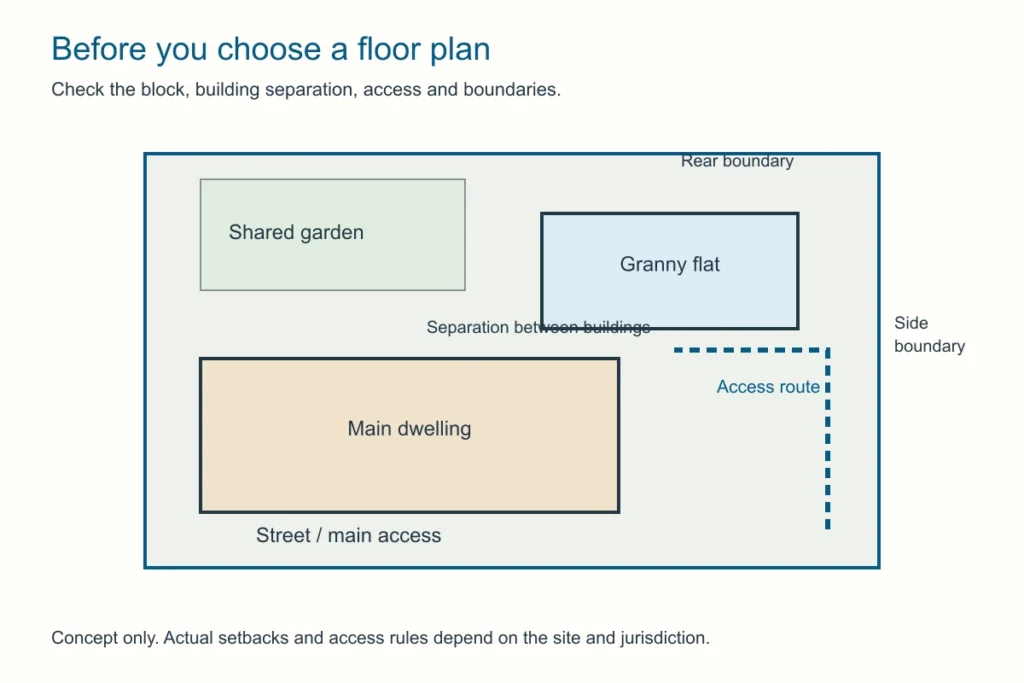
| Building position | Required boundary and building separation distances |
| Property constraints | Flood, bushfire, heritage and other mapped controls |
| Access and services | Pedestrian access, parking, drainage and connection requirements |
Take those answers back to the supplier. Request a site plan showing the whole property, including the existing dwelling, rather than a detached floor plan with no boundaries. This is also the point to check delivery access if you’re considering a factory-built module.
Planning assessment and building approval do different jobs
Some proposals can proceed without a council development application when the relevant requirements are satisfied. Other sites or designs need assessment. Ask the planner to identify the route for your proposal; don’t assume a private building certifier can waive a planning requirement.
The building work also needs an appropriate approval package. Your certifier can explain the drawings, structural information, energy assessment and inspections needed for the selected construction method. Give them the supplier’s specifications before ordering. A claim that a module is suitable for Queensland doesn’t establish that its foundations, siting or connections suit your address.
For the sequence of decisions and documents, see our approval guide. Keep the approval and construction tasks in one schedule so the factory order doesn’t overtake unresolved site questions.
Can you rent a Queensland granny flat to someone else?
Queensland removed the family or household relationship restriction in September 2022. However, the government guidance also warns that an existing approval can contain occupancy conditions requiring a change application. A change in use may raise fire-safety or sound-transmission requirements. Check those conditions before advertising an older granny flat.
The Residential Tenancies Authority explains the rental arrangements for secondary dwellings. The agreement depends on whether the accommodation is self-contained or shares facilities. Describe the actual arrangement when seeking advice, including access to the main house and any shared kitchen.
Record how utilities, garden access and maintenance will work. Those practical details matter to both households even when planning permission is settled. Our rental-law guide provides further questions to take to the relevant adviser.
Build a budget around the approved scope
Request separate amounts for design, reports, approvals, the dwelling, foundations, service connections and external work. A flat site near existing services presents a different job from a sloping block with difficult truck access. Ask who pays for unexpected excavation and what evidence triggers a variation.
Use the cost calculator to organise assumptions, then replace them with written quotes. Compare suppliers in the supplier hub once you know whether you want materials only, a delivered module or a managed build.
Frequently Asked Questions
Is 80 m² the Queensland granny flat limit?
No. Check the local planning scheme and the definition of floor area applying to your property.
Does permission to rent remove building approval?
No. The rental reform and approval of the building are separate matters.
Can I convert an existing shed?
Have council and a building certifier assess the proposed residential use and required building work before buying a fit-out.
Primary sources
These cards are an editorial summary of official pages. The Granny Flat Guide is not a certifier, council or licensed builder. Check the live official URL before you lodge or sign.
- Your Home (Australian Government)Your Home: Australia's guide to environmentally sustainable homes
- Australian Building Codes BoardNational Construction Code
- Queensland PlanningPlanning Act 2016
- QBCC (Queensland)Queensland Building and Construction Commission licensing
See our editorial standards for how we research and update guides.
Related guides