Granny Flat Regulations Australia: State Rule Comparison
Granny flat regulations in Australia depend on the state, the local planning controls and the proposed use. A size limit is only one part of the assessment. Compare the applicable definition of floor area, approval route and property constraints before comparing building designs.
By The Granny Flat Guide Team. Updated 2 October 2026. About our research.
Compare the rules, not just the largest number
Use this table to find the right source. It isn’t an eligibility certificate or a national set of minimum lot sizes. A state provision may have exceptions, and a larger proposal may belong to a different development category with different assessment requirements.
| Jurisdiction | Starting point | Read next |
|---|---|---|
| NSW | Housing SEPP secondary-dwelling requirements; distinguish CDC from DA | NSW Planning |
| Victoria | Small second dwellings up to 60 m²; planning exemptions have conditions and building permits remain required | Victorian Planning |
| Queensland | Local scheme and building requirements; no single statewide 80 m² rule | Queensland guide |
| South Australia | Ancillary accommodation in the Code; the 2024 amendment increased the floor-area criterion to 70 m² | SA guide and amendment source |
| Western Australia | R-Codes ancillary-dwelling provisions and local scheme controls | WA information sheet |
| Tasmania | Secondary-residence provisions; distinguish the proposed 90 m² amendment from rules in force | Commission amendment record |
| ACT | Territory Plan, lease and building requirements for the block | ACT Planning |
| Northern Territory | Planning Scheme provisions and the applicable building-control requirements | NT Planning Scheme |
Local changes can matter as much as the state framework. Our Augusta Margaret River report, for example, covers a zoning-specific scheme change. It shouldn’t be applied to every WA backyard.
Read the floor-area definition
Brochure area, internal living area and the area measured for planning purposes may differ. Ask the designer to show the calculation used for approval and identify how walls, covered outdoor areas, garages or other features are treated. Don’t subtract rooms from a supplier’s headline area yourself.
Victoria’s applicant guide explains its measurement method. That is why describing every state’s limit as “internal area” is misleading. Take the correct definition into your design brief before comparing floor plans.
Check planning and building requirements separately
A planning exemption can remove the need for one application while leaving building requirements intact. A complying-development route has its own eligibility tests. The term “no council approval” doesn’t tell you which documents are needed or which authority must assess the work.
Request a written explanation for your property: proposed use, assessment category, required approvals, responsible practitioners and any conditions to satisfy before construction. Our approval guide sets out how to organise those decisions and the supporting documents.
Investigate constraints before paying for a building
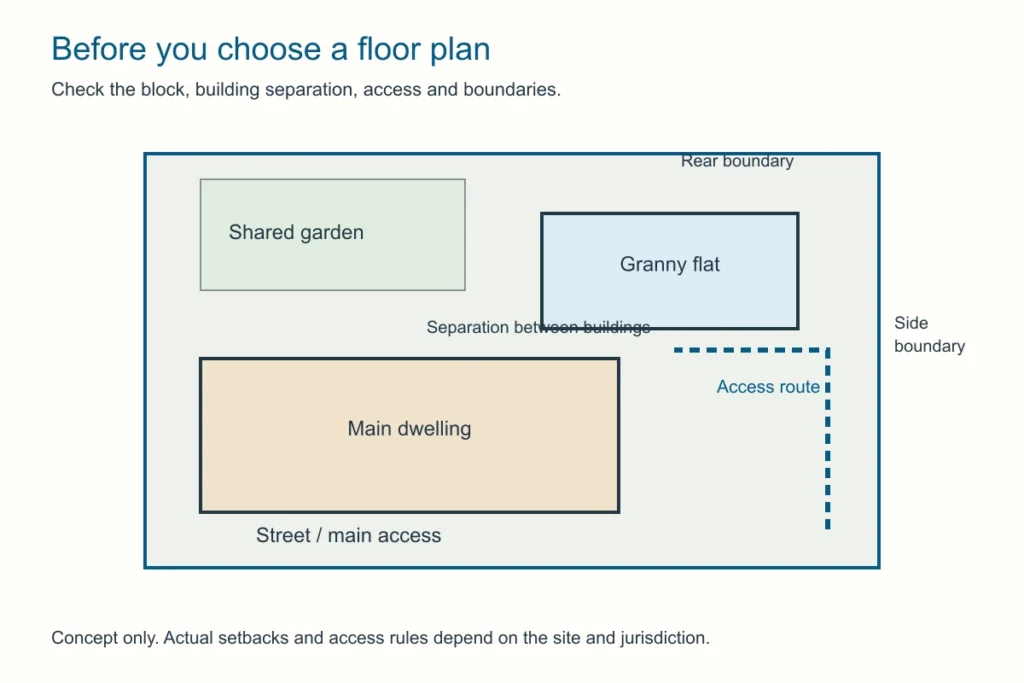
Check title restrictions, easements, boundaries, existing structures and mapped controls. Locate sewer and stormwater services, and consider access for construction or module delivery. A building that fits within an area limit may still be impractical in the available part of the site.
Ask the supplier what happens if the site assessment requires a redesign. Record which preliminary fees are refundable, who owns the drawings and whether the quoted price depends on foundation, access or connection assumptions. Keep unresolved work visible in the budget.
Separate current rules from reform announcements
An announcement, consultation, decision and commencement date are different events. A proposal to increase a size allowance isn’t the same as an operative planning provision. When reading a news report, follow its primary source and check the date before ordering a larger design.
For Tasmania’s 2026 proposal, the Commission record gives the assessment history. Ask the planning authority which provisions apply to the application you intend to lodge. Avoid a supply contract that assumes a future rule will be approved on a particular date.
Frequently Asked Questions
Is there a national granny flat size limit?
No. Use the provisions applying to the location, use and approval pathway.
Can I rent any approved granny flat?
Check the approved use, existing conditions and the tenancy or short-stay requirements relevant to your arrangement.
Can one design be used in several states?
It can be a starting point, but the siting, area calculation, construction specification and approval documents need review for each property.
Primary sources
These cards are an editorial summary of official pages. The Granny Flat Guide is not a certifier, council or licensed builder. Check the live official URL before you lodge or sign.
- Your Home (Australian Government)Your Home: Australia's guide to environmentally sustainable homes
- Australian Building Codes BoardNational Construction Code
- NSW Planning PortalState Environmental Planning Policy (Housing) 2021
- Victorian Building AuthorityBuilding Act 1993 / small second dwelling settings
- Queensland PlanningPlanning Act 2016
- WA Planning (DPLH)Planning and Development Act 2005
- PlanSA (South Australia)Planning, Development and Infrastructure Act 2016
- QBCC (Queensland)Queensland Building and Construction Commission licensing
See our editorial standards for how we research and update guides.
Related guides