Granny Flat Approval Guide: From Site Check to Handover
Granny flat approval starts with confirming what your property can accommodate, then documenting how the building will meet the applicable requirements. Planning exemptions, complying-development routes and building permits differ by state. A supplier’s standard design doesn’t establish approval for your address.
By The Granny Flat Guide Team. Updated 2 October 2026. About our research.
Start with the property and intended use
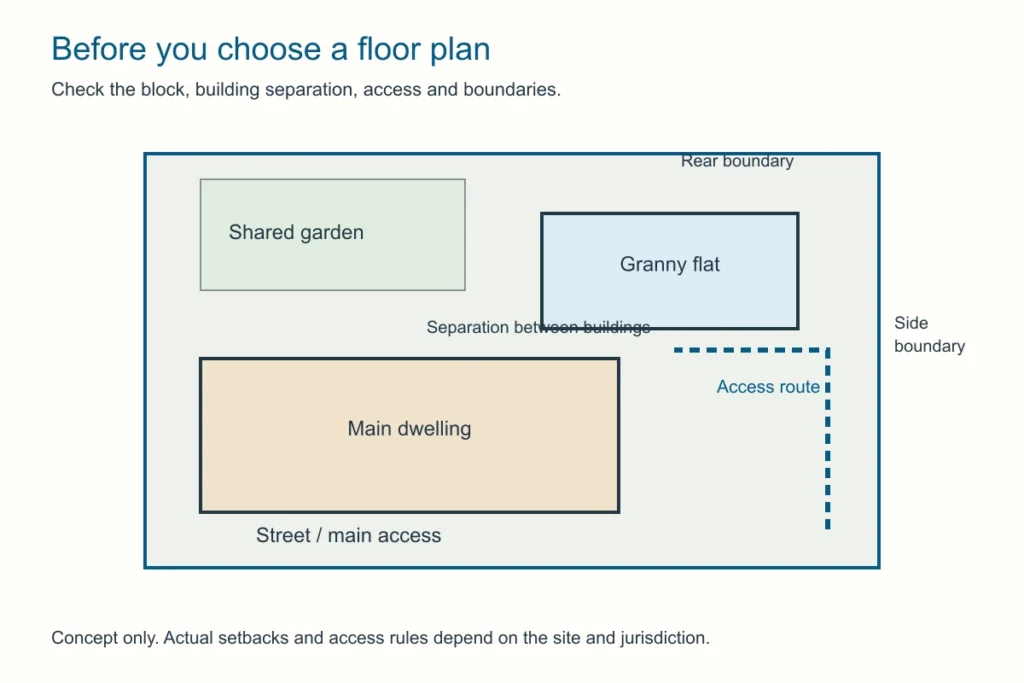
Bring a survey or reliable property plan, title information and a short description of what you want to build to the first planning discussion. Include the existing house, proposed footprint, boundary positions, access and known services. Say whether the dwelling is for family, a tenant or another use; don’t assume those arrangements have identical requirements.
Ask which planning controls apply to the lot and whether a separate application is required. Easements, protected trees, heritage, flood and bushfire controls can affect the design or require further investigation. A neighbour’s approval is useful background, but it doesn’t answer these questions for a different site.
Keep the advice in writing. If the proposed location or use changes, have the advice checked again before paying to revise the full drawing package. Our rules hub links to the relevant state guides.
Establish the approval pathway
In NSW, the secondary-dwelling guidance distinguishes complying development from a development application. Other states use different processes. In Victoria, for example, qualifying small second dwellings can be exempt from a planning permit while still needing a building permit.
Ask the practitioner advising you to identify the approval route, its conditions and the authority responsible. Don’t convert “no planning application required” into “no approvals required”. Equally, don’t budget for a planning application simply because an interstate article says every granny flat needs one.
The approval-process guide helps separate planning and building decisions. Use the pathway tool to collect questions, then obtain a property-specific answer. A browser tool can’t assess an easement or certify a design.
Commission a coordinated drawing package
Ask for a written list of the documents needed before engaging separate consultants. The site plan, floor plans, elevations, structural design and relevant energy or other assessments should describe the same revision. Otherwise, a late change to a window or wall can leave the supporting documents inconsistent.
| Document or task | Question to resolve |
|---|---|
| Site plan | Does it show boundaries, existing buildings, access and proposed work? |
| Structural design | Who designs foundations and site-specific connections? |
| Energy and service information | Does it match the final drawings and selected appliances? |
| Application and fees | Who lodges, answers questions and pays each charge? |
| Construction inspections | Who books them, and which work must remain visible? |
For a kit, distinguish supplier engineering from the additional site design you must commission. For a module, include transport, lifting and installation responsibilities in the brief. Compare these arrangements through our supplier hub.
Confirm construction can start
Before work begins, obtain the approvals and appointments required for the project. Have the responsible certifier or building surveyor explain the inspection schedule and any conditions that must be satisfied first. The document names differ across Australia; a NSW Construction Certificate or Occupation Certificate shouldn’t be presented as a universal national term.
Give the builder the approved drawings and conditions. Make sure the contract names the same work and identifies who handles variations. If a substitution changes structure, energy performance, access or another assessed feature, ask whether approval documents need updating before it is installed.
Don’t rely on a salesperson’s assurance that paperwork can follow later. A delivery date is a commercial milestone, not evidence that excavation, installation or occupation has been authorised.
Keep inspections and handover records together
During construction, keep approved revisions, inspection records, consultant certificates and written changes in one project folder. Ask who checks the completed service connections and which certificates are still outstanding. Photograph work before it is covered where appropriate, but don’t treat photographs as a substitute for required inspections.
At handover, obtain the completion or occupancy documents applicable to your jurisdiction, along with warranties, operating instructions and the defect process. Ask the certifier to confirm when the dwelling can be occupied. Keep the approval record available for future insurance, rental or sale enquiries.
Budget for these tasks in the cost breakdown. An amount described as “approvals included” should have a scope identifying the actual reports, fees and services covered.
Frequently Asked Questions
Do all granny flats need a council planning application?
No. Some proposals qualify for other approval routes or a planning exemption. Building requirements still need checking for the specific work.
Does a factory-built module arrive approved for my site?
Its documentation may support an application, but it doesn’t settle siting, foundations, services or local approval requirements.
Who should explain the documents I need?
Start with the relevant planning authority and the certifier or building surveyor for your jurisdiction. Ask them to identify their responsibilities and any additional consultants.
Primary sources
These cards are an editorial summary of official pages. The Granny Flat Guide is not a certifier, council or licensed builder. Check the live official URL before you lodge or sign.
- Your Home (Australian Government)Your Home: Australia's guide to environmentally sustainable homes
- Australian Building Codes BoardNational Construction Code
- NSW Planning PortalState Environmental Planning Policy (Housing) 2021
- Victorian Building AuthorityBuilding Act 1993 / small second dwelling settings
- Queensland PlanningPlanning Act 2016
- WA Planning (DPLH)Planning and Development Act 2005
- PlanSA (South Australia)Planning, Development and Infrastructure Act 2016
- QBCC (Queensland)Queensland Building and Construction Commission licensing
See our editorial standards for how we research and update guides.