Granny Flat No Council Approval: Check What Is Exempt
A “granny flat no council approval” advertisement doesn’t establish what your property needs. It may describe a planning exemption or a certification route outside a council development application. Ask which approval is unnecessary, which rule creates the exemption and what permissions remain.
The answer depends on the Australian jurisdiction, land and proposed use. A supplier’s generic statement can’t resolve all three. Start with our state rules hub, then obtain property-specific advice before paying for a building.
Separate planning, building and occupation
Planning controls address whether and how the proposed development can occur on the land. Building requirements address the construction. Completion and occupation requirements come later. An exemption in one part of that process doesn’t automatically remove the others.
Ask the practitioner to write down the route for your project. Include the applicable conditions, required documents and who is responsible for each step. If a salesperson uses “approved” to describe a design, ask whether that means engineering for a product or an actual approval for your address.
Keep that distinction in your contract discussions. A kit can arrive with documentation that still needs site-specific assessment. Delivery and assembly don’t demonstrate that residential occupation is permitted.
What do the state examples show?
| Example | What to check |
|---|---|
| NSW complying development | A CDC is an approval route for eligible proposals, not no approval |
| Victorian small second dwelling | Planning exemptions have conditions; a building permit remains required |
| WA ancillary dwelling | Check the R-Codes exemption criteria and separate building requirements |
| Queensland secondary dwelling | Check the local planning scheme and applicable building approval |
The NSW secondary dwelling guidance explains complying development and other assessment questions. If your proposal can’t meet the CDC requirements, don’t assume a development application is guaranteed to succeed.
Victoria’s small second dwelling guidance distinguishes planning exemptions from building permission. The prescribed size definition and other conditions matter; a supplier’s floor-plan label isn’t enough to establish eligibility.
For WA, use the ancillary dwelling information sheet. For Queensland, start with the state guidance and the local scheme. These are different frameworks, so don’t transfer one state’s terminology or limits to another.
What can prevent the advertised shortcut?
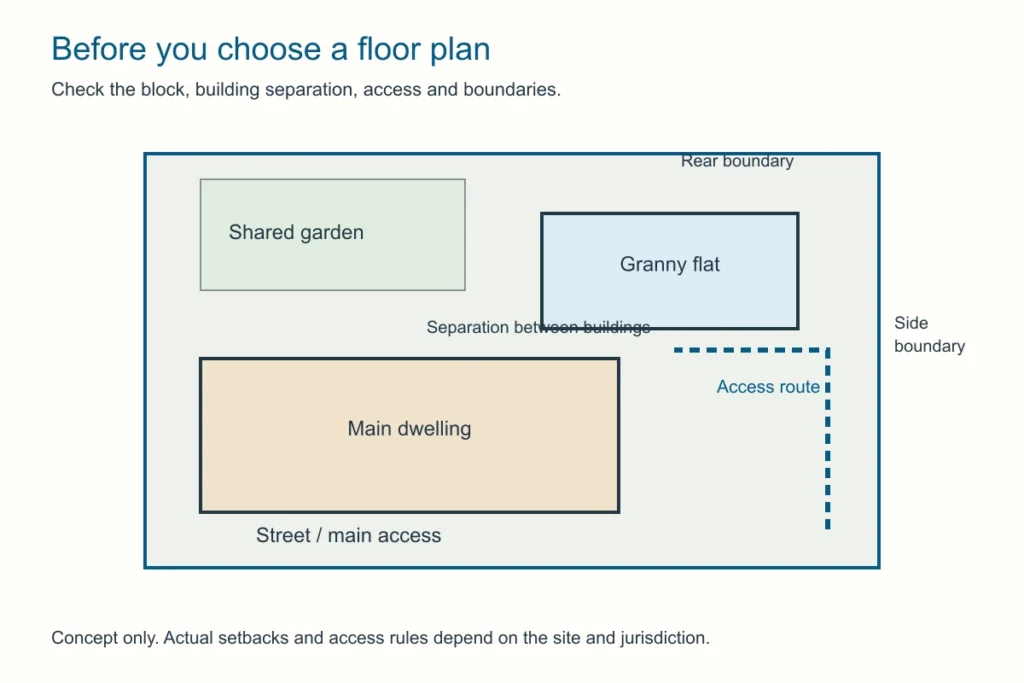
Ask about zoning, overlays, title restrictions and the actual building envelope. The designer needs to know the relevant constraints before placing a standard plan on the site. A neighbour’s approval can provide useful context, but it isn’t proof that your proposed building qualifies.
If a title covenant or estate restriction is involved, obtain advice on that issue separately. A planning permit isn’t a universal cure for private restrictions, and a planning exemption doesn’t establish a right to ignore them.
For an existing garage or shed, supply its approval history and proposed new use. Converting it to a dwelling needs its own assessment; a change to rules for new small homes doesn’t retrospectively certify an existing structure.
Ask four questions before paying a deposit
- Which current provision permits this proposal on this land?
- What approval, permit or exemption evidence is required?
- Who supplies the site-specific design and supporting reports?
- What happens under the contract if permission isn’t obtained?
Get answers in writing and check any unresolved conditions with the responsible practitioner. If the supplier’s promise conflicts with that advice, resolve the conflict before purchase. Our quote comparison guide helps identify which approval services are actually included.
Frequently asked questions
Does a building permit guarantee insurance?
No. Explain the structure, construction stage and intended occupancy to the insurer and confirm cover separately. Approval and insurance answer different questions.
Can a tiny house avoid the same process?
Its structure and intended use need assessment under the applicable rules. Wheels aren’t a universal exemption. See our tiny house comparison.
What if construction has already started without permission?
Obtain advice on the actual approval gap from the relevant authority and a qualified practitioner. Don’t assume retrospective approval is available or that completing the work will resolve the issue.
By The Granny Flat Guide Team. Last updated October 2026. About our research · Project budget calculator
Primary sources
These cards are an editorial summary of official pages. The Granny Flat Guide is not a certifier, council or licensed builder. Check the live official URL before you lodge or sign.
- Your Home (Australian Government)Your Home: Australia's guide to environmentally sustainable homes
- Australian Building Codes BoardNational Construction Code
- NSW Planning PortalState Environmental Planning Policy (Housing) 2021
- Victorian Building AuthorityBuilding Act 1993 / small second dwelling settings
- Queensland PlanningPlanning Act 2016
- WA Planning (DPLH)Planning and Development Act 2005
- PlanSA (South Australia)Planning, Development and Infrastructure Act 2016
- QBCC (Queensland)Queensland Building and Construction Commission licensing
See our editorial standards for how we research and update guides.
Related guides