Granny Flat vs Home Extension Australia: Cost, Approval and Resale
Choosing a granny flat or a home extension depends on how independently the extra space needs to work. Compare access, privacy, kitchen and bathroom needs, approval requirements and complete project costs. Extra floor area alone is not a fair comparison.
Price your options with the granny flat cost breakdown and cost calculator. If family is funding the build, see ATO granny flat agreement explained.
Side-by-side comparison
| Factor | Granny flat (secondary dwelling) | Home extension |
|---|---|---|
| Independence | Own entry, kitchen, bathroom | Shares main house circulation |
| Typical approval | Secondary dwelling pathway (CDC/DA or state code) | Alterations / additions pathway |
| Rental potential | Often rentable as a small dwelling (state rules apply) | Hard to lease as a separate tenancy |
| Privacy | High if sited well | Low between rooms |
| Resale story | “Dual living / income” appeal in many markets | “Bigger house” appeal; may hit overcapitalisation |
| Services | New connections or extensions of mains | Usually ties into existing services |
Cost: what each budget actually buys
Research planning bands for a mid-spec 1–2 bed granny flat commonly sit in the high-five to low-six figures once site works and approvals are included (see line items). Extensions quote per square metre for living space, but buyers forget:
- Temporary accommodation if the house is opened up
- Matching existing roof, brick and window profiles
- Engineering for openings in load-bearing walls
- Whole-of-house NCC energy upgrades when alterations trigger them
A granny flat’s “extra” costs are slab, services runs and a second kitchen. An extension’s “hidden” costs are disruption and matching fabric. Get three itemised quotes for each path before you decide: and include temporary fencing, skip bins and landscaping make-good in both budgets so the comparison is honest.
Approval differences that change timelines
Secondary dwellings have published size, setback and parking tests in many states (NSW Housing SEPP CDC pathways, Victoria Part 5 small second dwellings, Queensland secondary dwelling codes). Extensions follow alterations rules for the primary dwelling and may need neighbour notification or different overlays.
Neither path is “approval-free.” Unlawful builds hurt insurance and resale. If you’re unsure which route applies, start with regulations by state and the approval guide. But don’t assume a CDC-style secondary dwelling is always faster than a simple rear addition. Overlays decide the clock, not the brochure.
Resale and valuation
Valuers treat a compliant, rentable granny flat as a different product from an extra bedroom on the main house. In tight rental markets, income evidence can support value. In luxury suburbs that already have large homes, an extension that fixes a poor floor plan may outperform a tiny flat at the back.
Neither automatically recovers 100% of build cost. Read do granny flats add value for the nuance. Poor workmanship or missing certificates hurts both asset types: and that’s before you factor in buyer due diligence at settlement.
When an extension wins
- You want one household to share meals and care without walking outside
- The lot fails secondary dwelling setbacks but allows an addition
- You need a master suite or living room, not a second kitchen
- Body corporate or title constraints block a separate dwelling
If the second occupant needs a kitchen at 2am without walking through your living room, an extension won’t deliver that. If they want to share dinners every night, don’t build a backyard dwelling just because the internet said granny flats add value.
When a granny flat wins
- Ageing parents need independence with proximity
- You want lawful long-term rental income
- Privacy between adult children and parents matters
- You may sell with a dual-living marketing story
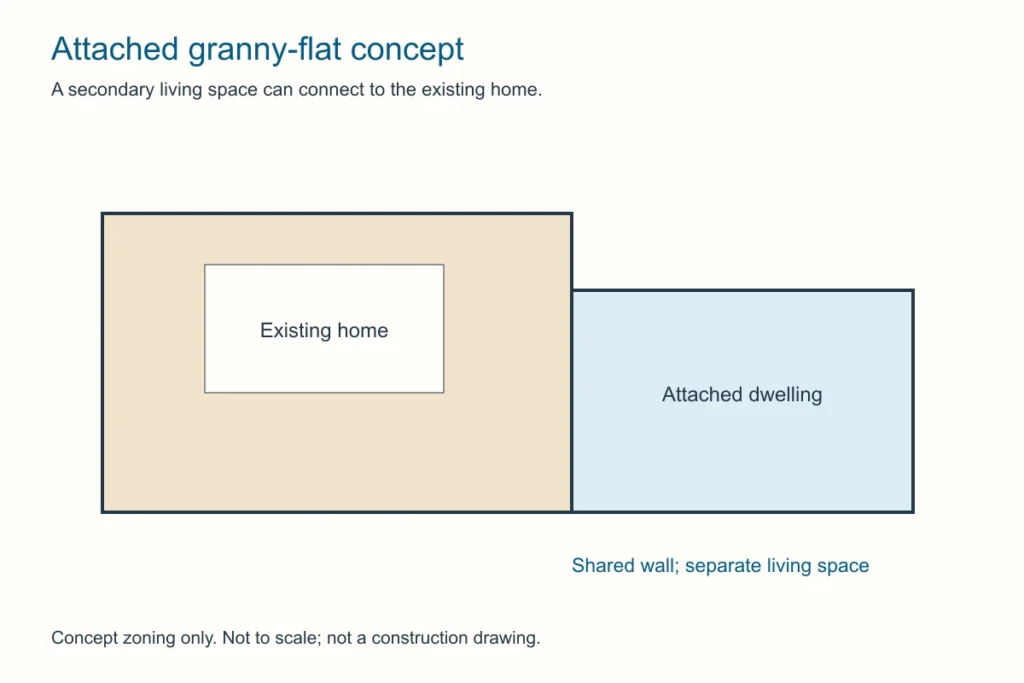
If rental income is part of the brief, have the proposed accommodation and tenancy arrangement assessed. Adding a bedroom does not establish approval for a self-contained dwelling, and a second kitchen does not resolve the legal category. Ask the planner to define the proposal before comparing finance or rent.
Compare build methods via prefab, custom builders and the supplier hub. More context on the guides hub. If you need one household under one roof, an extension is usually the honest choice. If you need two households, don’t pretend an extra bedroom is a granny flat.
Frequently Asked Questions
Can I convert an extension into a granny flat later?
Sometimes, if you can create a separate dwelling that meets planning and fire separation rules. It is rarely cheaper than designing correctly first.
Which is faster to approve?
It depends on the LGA and pathway. Some secondary dwellings qualify for complying development; complex extensions can be quicker than a non-compliant flat. Ask a planner for both scenarios on your lot.
Will banks treat them differently for lending?
Lenders vary. Income from a lawful secondary dwelling may be considered differently from an unrentable extension. Speak to your broker with plans and certificates.
Does family funding change the choice?
Granny flat interests and CGT rules are about occupancy rights in a relative’s property, not about preferring one construction type. See the ATO agreement guide.
Disclaimer: The Granny Flat Guide Team provides research comparisons, not financial, valuation or planning advice. Confirm figures and pathways for your address.
Sources: State planning portals via rules by state · ABCB (NCC classification context)
By The Granny Flat Guide Team
Primary sources
These cards are an editorial summary of official pages. The Granny Flat Guide is not a certifier, council or licensed builder. Check the live official URL before you lodge or sign.
- Your Home (Australian Government)Your Home: Australia's guide to environmentally sustainable homes
- Australian Building Codes BoardNational Construction Code
- NSW Planning PortalState Environmental Planning Policy (Housing) 2021
- Victorian Building AuthorityBuilding Act 1993 / small second dwelling settings
- Queensland PlanningPlanning Act 2016
- WA Planning (DPLH)Planning and Development Act 2005
- PlanSA (South Australia)Planning, Development and Infrastructure Act 2016
- QBCC (Queensland)Queensland Building and Construction Commission licensing
See our editorial standards for how we research and update guides.